March 21, 2017

The Azure Window, before and after

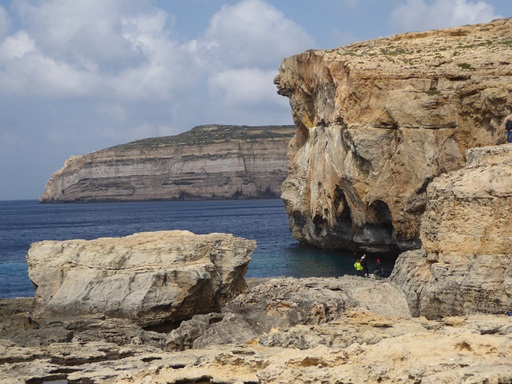
My last blog was about the collapse of the Azure Window on the Maltese island of Gozo. A week later I was able to visit the site and see it for myself. I have roughly sketched in where the rock arch was -

And a reminder of how it was -

There was a guard located at the start of the path that used to lead to the arch, he was stopping anyone from going that way.

Now the arch has gone, the piece of rock jutting out from the top of the cliff looks like a face, maybe a gargoyle!

© Liz Price

March 9, 2017

The Azure Window on Gozo has collapsed

The famous limestone rock arch known as the Azure Window on the island of Gozo has collapsed. Gozo is Malta's 'sister' island. The Azure Window was one of the main attractions on Gozo but collapsed into the sea in a storm on 8 March 2017.

Known as Tieqa tad-Dwejra in Maltese, the rock arch was an icon of Malta and internationally known. Not only did the arch collapse, but the stack also disappeared.

In good weather tourists used to walk over the arch. The arch as it was, photo from The Telegraph -

Photo from Times of Malta -

It seems there was a raging sea and the arch collapsed into the sea. Even the stack disappeared as well. The Maltese Prime Minister and other ministers all expressed their sorry soon after it happened.

In 2013 geologists knew the areas was suffering from erosion but the arch was expected to last for decades. In 2016 people were no longer allowed to walk across the bridge. A nice photo of the arch as it was at low tide, taken from NYT -


I visited Malta in 2015 but didn't have time to go to Gozo and also the weather wasn't at it's best in January. And unbelievably I had already booked to go to Malta on 14 th March and had intended to go to Gozo. I will still go - but I won't be able to see the Azure Window.

--

November 12, 2016

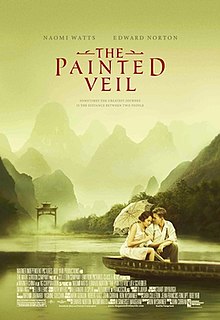
The Painted Veil filmed in China

The Painted Veil is a novel by Somerset Maugham published in 1925. It is set mostly in China. It has been adapted for the screen 3 times. The last film version was 2006.

Most of the outdoor scenes were filmed in karst landscape in Guangxi. Guangxi is an autonomous region bordering Vietnam. The former capital was Guilin, which is surrounded by limestone hills and caves. Yunnan lies to the west. Filming was done in Yizhou, which is an area known for its karst formations.

Painted-veil-poster.jpg

November 7, 2016

Bear Grylls killing bats in China on Born Survivor

I have already mentioned how Bear Grylls has been criticised for killing bats in China, see my blog of 2015. And I wrote about this on my Caves of Malaysia website.

The Discovery programme was called Bear Grylls, Born Survivor. It was first shown in 2010. In the USA it was called Man vs Wild.

I didn't see the programme then. But I did see it in 2016. Series 4, Ep 9 on Discovery Channel. The episode featured Bear Grylls "sharing invaluable survival strategies" when he was in a southern China jungle after a typhoon. From TV guide UK : "Adventurer Bear Grylls visits a region devastated by a typhoon and has to tackle swollen rivers, climb large waterfalls and use an ancient tribal technique to catch bats for food".

He reaches a cave and says that China has the largest number of unexplored caves in the world. And that American fighters used caves for shelters.

To go into the cave, he makes a torch by splitting bamboo, packs it with dry leaves, ties it together with vine and lights. The bats inside mean food. He comments on the smell of ammonia and says the spores from the bat guano are dangerous as they carry histoplasmosis. He uses light and smoke from his torch to spook the bats. He says bats have been around for 50 million years and use echo location.

He goes out of the cave in order to work out how to catch the bats. He makes a trap  /  net from branches and vines [it looks like a large lacrosse stick]. We then see him wildly waving the trap around in the entrance and a message at the bottom of the screen says something to the effect that killing bats is illegal in the UK and some countries. He continues to wave the trap around and catches a bat and holds it up to show the camera. Then suddenly the scene changes to him sliding into a river.

Later on he catches a large frog, he holds it up, then the next shot we see him eating a leg of the skinned frog, raw.

That evening he makes a raised hammock and makes a fire to cook his bats. He also sets a rat trap using bat guts as bait. We see him skewer 2 bats onto a stick and roast them. He says bats carry rabies so must be well cooked. We see him eating one, he doesn't like the taste but they are warming. In the morning he finds a large rat in a trap and cooks that.

--

Bear Grylls was apparently sacked by Discovery over a contract dispute according to this report in March 2012. It obviously wasn't a permanent thing as he has been seen on Discovery since then.


September 26, 2016

Carlsbad Caverns visit 1994

In March 1994 I was in the USA for the first time. My first night was spent in El Paso, which is a border town in the extreme western corner of Texas. It stands on the bank of the Rio Grande with the Mexican state of Chihuahua on the other side. The next day I took the bus to Carlsbad Caverns in New Mexico, it is 145 miles northeast of El Paso. The bus dropped me at White City near the Carlsbad Hotel and I then managed to get a lift to Carlsbad Caverns, 7 miles away.

The show cave entrance complex is situated in a hill overlooking the Chihuahuan Desert.


I paid for the Red Tour, $5 and took the elevator down 750' into the cave. I stepped out into a concrete world of shops, cafe, lunch room etc. A big chill immediately hit me as it was so much cooler than the outside.

I did the self guided walk of about an hour around the Big Room, which used to be the world's largest chamber until Sarawak Chamber in Mulu was found. The chamber is full of stal, some is huge. I saw the Bottomless Pit.


There was another tour, the Blue Route, which uses the natural entrance but the last tour was at 2 pm.

A very nice cave, one of the best I have seen, just a pity I couldn't see more. There was a good display in the exhibition area.

5 miles from Carlsbad is Lechuguilla Cave in the Guadalupe Mountains.

From Carlsbad Cavern I went to Carlsbad town, 27 miles away -

See more on the Carlsbad Caverns homepage.


September 25, 2016

Underground London - Manor Gardens Ice House

There is an ice house in Manor House Gardens in Lee, SE London, in the borough of Lewisham.

The Manor House was built in 1772 as a private residence for Thomas Lucas who was an important man in Guy's Hospital. Today it is used as a public library.

It is thought the ice house was built in 1773. Ice houses are buildings used to store ice throughout the year, mostly before refrigerators were invented. Some were insulated buildings, others were man-made underground chambers. They may have been close to natural sources of winter ice, if not, ice had to be transported in. During the winter, ice and snow would be taken into the ice house and insulated with straw or sawdust. It would remain frozen for many months, often until the following winter, and could be used as a source of ice during summer months.

It's not clear how long the Manor Gardens ice house was used for ice. At the end of the 19th century it was used as stabling for ponies belonging to a local builder. During the Second World War it was used as an air raid shelter for occupants of houses in Manor Lane. It was restored by the Lee Manor Society in 2000.

The ice house is made of brick. Ice would have come from the nearby lake. Access today is by a new staircase, this is looking in from the entrance -


An ice well was linked by corridors to the ice stores -

Open House London describe the ice house as
Grade II listed ice well and underground chambers (1773) in Manor House Gardens park, which provided ice for nearby Manor House, former home of Sir Francis Baring. Cited in 2002 Civic Trust Awards.

---

September 19, 2016

Underground London - Crystal Palace subway

The Crystal Palace subway is slowly being restored and is occasionally open to the public. It dates back to Victorian times and was built to provide access to the Crystal Palace. It goes under the main road, Crystal Palace Parade -

The Crystal Palace was the huge iron and glass building used for the Great Exhibition in 1851 in Hyde Park. After the exhibition it was rebuilt at the top of Sydenham Hill in 1854 but was destroyed by fire in 1936.

There were 2 stations serving the Palace, one was the low level station and the other was a new high level one built in 1865 on the western side of Crystal Palace Parade. The subway was then built for access to the Palace. Image of the railway and Palace from Illustrated London News -

The Subway was designed with groined arches of coloured bricks and stone, resting on 15 columns. It was meant for first class passengers. It led to a roofed vestibule and 4 staircases. It opened at the end of 1865.

During the Second World War the subway was used as an air raid shelter. The subway was modified to provide sleeping areas, a canteen, lavatories and drains. The High Level Station closed in 1954. However the subway was still used as a short cut to access the motor racing in the park.

The subway survived but the roofed vestibule didn't. In 1972 the subway was listed by English Heritage. And since then it is slowly being restored.


Looking out to where the roofed vestibule used to be -


And looking back at the entrance -

See more on Open House London.

© Liz Price