Showing posts with label Underground London. Show all posts

August 20, 2025

Underground London - Ewell grotto

Ewell grotto is not underground and is rather tiny. But because it is called grotto I was curious to see it. It is located in the grounds of Ewell Court house, west of London. The house dates to the Edwardian period, 1870s.


It is known as The Fernery/Grotto.  It was part of a large conservatory attached to the house and was part of beautiful grounds designed by John Henry Bridges and landscaped by Pulhams of Broxbourne. The conservatory  was taken down at the start of World War 2


The inside of the grotto is made from pulhamite. Pulhamite was a patented anthropic rock material invented by James Pulham (1820–1898) of the firm James Pulham and Son of Broxbourne in Hertfordshire. This artificial material is constructed by bricks and rubble coated with cement. It creates natural looking rocks and crannies and enables ferns and orchids to grow on soil pockets. 


The grotto is built on a natural spring which formed part of the watering system. The little pool retains its level naturally. The interior was originally fed by a water system and there is evidence of artificial lighting.

The grotto was heated by a copper kettle boiler with pipe running outside and around to the greenhouse that currently houses the new tearoom. The dome/lantern on top of the grotto could be raised or lowered according to the temperature. This gave heat and steam to allow the ferns and orchids to grow. The hexagonal dome -

See more on The Grotto Directory which gives more info on the house. 

See also Historic England entry. 


May 26, 2025

Underground London - Strand "Roman" bath

There is a hidden bathhouse just off The Strand, in London. Located in Strand Lane, it is known as the Roman bathhouse, although it isn't actually Roman.

To get there from The Strand, you walk past the old entrance to the Piccadilly railway, 


then follow this sign


The entrance is through the gate on the right -


According to the National Trust, prior to use as a bath, it was the remains of a cistern built in 1612 to feed a fountain in the gardens of the old Somerset House, then a royal palace. After a long period of neglect and decay the baths were brought back into use in the 1770s as a public cold plunge bath.

"The bath chamber is covered by a full brick and stone vault and contains the bath and a 1920s settling tank built at the eastern end. The bath is made of shallow, wide Tudor bricks, with some patched repairs made from frogged bricks dating after 1750. The brickwork of the walls and vaults hasn’t been officially dated, but most probably dates from the 18th century."


The bath is not normally open to the public, but from 22 May to 2 July 2025, it is housing an audio-visual presentation entitled The River's Stomach (Songs of Empire). I actually found this very weird and won't go into details here. But that is the reason there are plastic "Roman eels" in the bath!

See more on the National Trust page and also on IanVisits and his more recent blog which features the art presentation.


April 9, 2025

Pope's Grotto, Twickenham, London

Pope's Grotto near Twickenham in London has been on my "to do list" for years, but as it has very limited open days I was never able to visit. Then in January 2025 I saw tickets advertised for the year so immediately bought one for 5 April.

Alexander Pope was one of England's most famous poets of his day. Born in 1688, he was a Catholic, and at the time there was religious repression. He also suffered from poor health and physical disabilities. To get away from the religious problems, Pope moved to Twickenham in 1719 and built a villa by the Thames on land he leased - Catholics weren't allowed to own land. He created a landscaped garden and dug a tunnel under the road to connect the house and garden. In 1720 Pope created the famous grotto, inspired by the styles of ancient Greece and Rome.

He was also inspired by the landscaped gardens of other mansions along the Thames, especially those with grottos decorated with shells, stones and crystals. In 1739 Pope visited a spa in Bristol. He liked the sparkling mineral rocks along the Avon Gorge and decided to adorn his grotto with minerals from all over the world. 

The villa was later demolished. A new building was erected in the 1940 and is now a school. English Heritage listed the site in 1952, the remaining traces of the gardens in 1987 and Pope's Grotto Preservation Trust set up in 2014. Since then conservation and preservation work has taken place.

The grotto is located in the Radnor School complex. Across the road is the Alexander Pope Hotel and several roads have "grotto" in their name.
Radnor School and  below the blue signboard is a plaque on the wall by the pavement mentioning the studs -


View of the Thames from inside the school grounds -


The grotto is located through the door shown above. Inside are a few information boards before the main entrance -

Inside on the left and right are 2 chambers with statues. The one on the left -


The entire walls and ceilings are covered with rocks and stones and minerals -


A wall decoration -

And on the ceiling -

The tunnel -


There are alcoves with benches in the tunnel -

This single piece of stal might have come from Wookey Hole, according to 


Old brickwork remains in place behind the walls -


- - -


I have been to Marble Hill grotto which is nearby, and also by the Thames. This grotto has references to Alexander Pope and his grotto.

- - - 

Pope's Grotto references :


A video on BBC from 2019

A detailed report on the Londonphile

Ianvisits 2024 report

October 11, 2024

Underground London - Marble Hill ice house

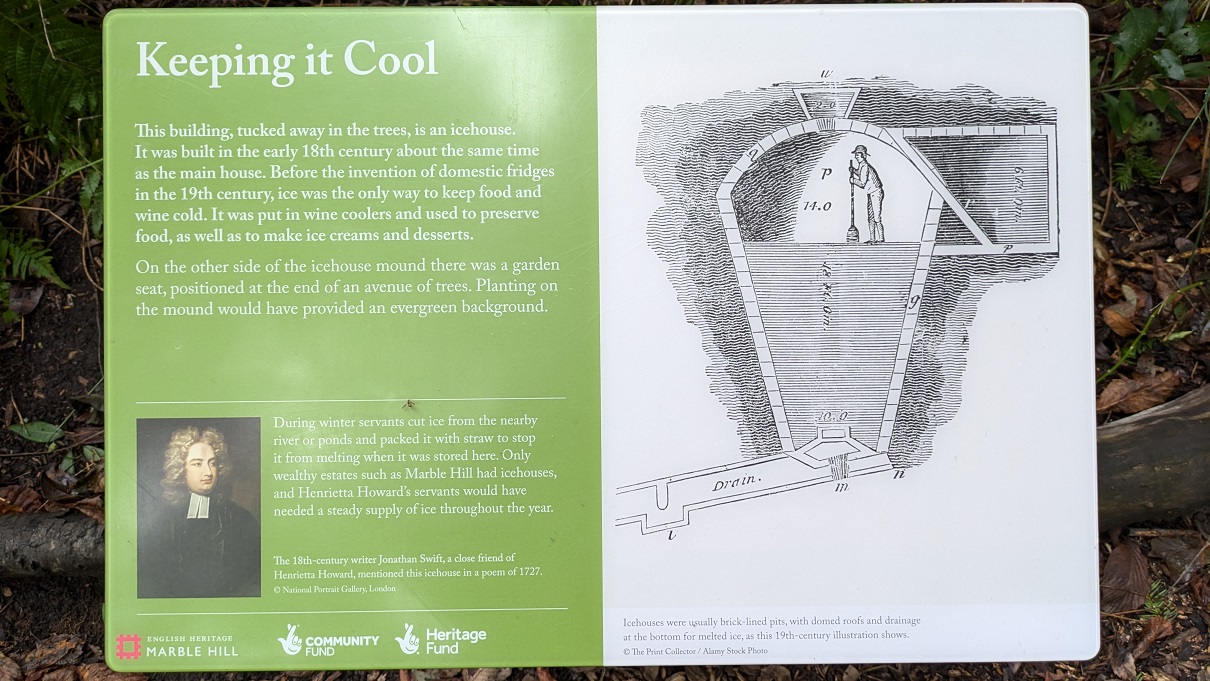
 After visiting Marble Hill grotto, I went to see the ice house. I mentioned it in my blog in 2021 when I wrote "On the north-west edge of the Marble Hill shrubberies, within the wooden fencing, is the brick-built icehouse (listed grade II). I will have to go back once all the renovations are finished."


There is not much to see, just the door


The restored garden seat, mentioned on the noticeboard -


Marble Hill grotto

 Marble Hill is a heritage house and park near East Twickenham in the London Borough of Richmond. The park extends down to the Thames. There is a man made grotto in the park.

I first went to look at the grotto in March 2021 and found it was under renovation. Marble Hill House and the gardens were also going through extensive renovation. There was very little to see at the grotto, see photos on my blog.

My next visit was at the end of Feb 2022, and found there was an archaeological dig in progress at the grotto. The whole area was being excavated. Over the following months, I checked the Marble Hill website but there was no mention of the grotto.

I didn't get around to going back until Oct 2024 and was surprised at the transformation. It looked so different. The first two photos are March 2021, then Feb 2022 and finally Oct 2024 -


The notice board says -
Grotto & 'Rustic Grot'
Henrietta Howard probably started building the grotto at Marble Hill in the 1730s. In 1739, while decorating the grotto, Henrietta wrote "I am at this time over head and ears in Shells". The poet Alexander Pope advised Henrietta on her garden, and this grotto may have been influenced by the one he created at his house nearby.

Grottoes were a popular addition to 18th-century gardens as part of the fashion for recreating the gardens of ancient Rome. The grotto would have been a secluded spot, and may have been used for dining, entertaining and contemplation. 

While Henrietta lived here there were two grottoes, both featured in a poem of 1764 by her neice Anna Chamber. The one you see today was described as a 'charming scene' and surrounded by flowering plants, the other, located to the south, was called a 'rustic grot', enclosed by huge trees and rocks.

The sketch shows Alexander Pope in his grotto in Twickenham, and is attributed to William Kent, 1730s. I still want to visit Pope's grotto, but it has very limited opening times.

I was surprised at how small the grotto is, just a small room. Very different to Scott's grotto I recently visited. It is gated so people can't go in.


Both Scott's and Henrietta's grottoes were decorated with shells. Some of the shells in Henrietta's grotto came from the Caribbean. Traces of the shell imprints -

Research is being carried out in the grotto -