July 19, 2015

Gouffre de Friouato, Morocco used for BBC Prized Apart game show

BBC game show Prized Apart used Gouffre de Friouato in one of the episodes. Friouato is in the Middle Atlas mountains in Morocco. I went to this enormous cave in 1976 and again in 1981 on the Cerberus Spel. Soc expeditions.

The programme was shown on BBC TV in England in July 2015. It was episode 3 that has the caving segment. From the BBC www:

Gouffre de Friouato

Up into the mountains to the north east of Fes lies the immense Friouato cave system, which includes North Africa’s largest cave.
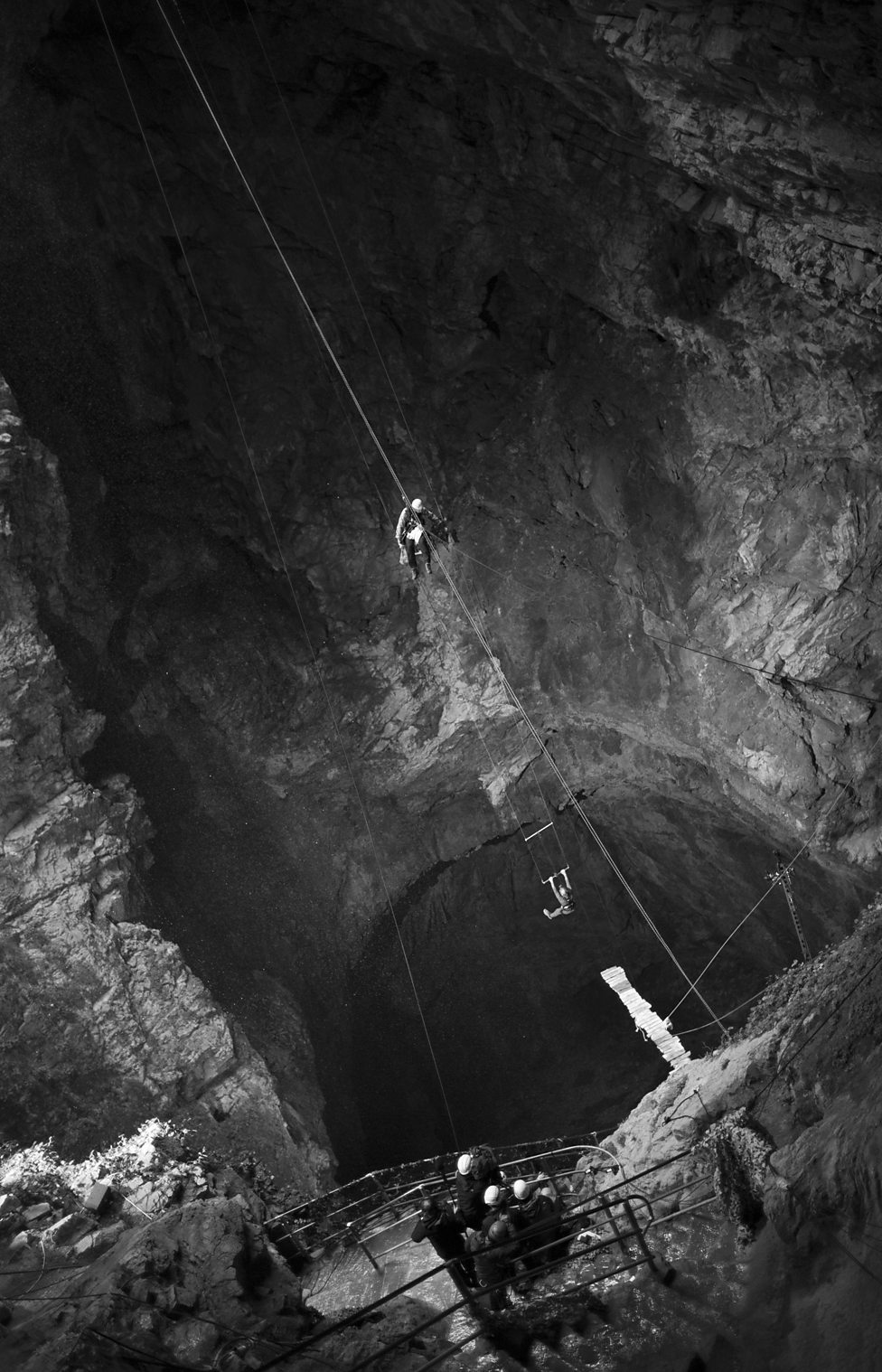
By the time the adventurers reached the cave for the third Survival Challenge it was mid-February, and the entrance to the cave was covered in snow, which fell steadily from the cave roof down into the 150 foot chasm below. The adventurers had to descend hundreds of steep steps to make their leap into the darkness...

When we were there is was hot as it was summer.

"Better to make a challenge at the top of a cave than the bottom

The leap of faith challenge in Episode 3 required our adventurers to jump from the top of the cave and grab hold of a trapeze, holding on for as long as possible. This meant bringing a huge amount of equipment down hundreds of narrow stairs in the dark. We had to bring down a weighted jib (a type of crane that you can attach a camera to), five cameras, a wooden beam, power tools, six rolls of camo netting and drapes, a gallery of six monitors and cabling, a lot of safety equipment - along with over 30 people. But was it worth it to capture the amazing footage of our adventurers as they dropped to the bottom? Absolutely!" [BBC www]

You can see the video here, the caving part starts approximately at 26 minutes.


June 22, 2015

Bear Grylls - Breaking Point episode 5

On my earlier blog I wrote about Episode 1, where Bear Grylls took 2 participants into a river cave in Mexico.

Episode 5 -  Claustrophobia.

Bear Grylls meets two men who spend their lives avoiding confined spaces – and takes them deep into the most frightening caves he can find. Mark almost died when he was buried alive by sand as a teenager. Meanwhile, Mike was accidentally imprisoned in a fairground ride dangling almost 20 metres off the ground. He now fears being trapped so much that he can’t even hug his wife.

Bear has a plan to help them face, and hopefully overcome, their worst fears. He’s heading out to one of the First World War’s most treacherous front lines, where the landscape is still punctured with trenches, caves and tunnels. But Bear will need to win Mike and Mark’s trust as he takes them deep underground.

You can see some videos on Discovery Breaking Point.

Inside Tunnel -
Bear brings Mike and Mark to a pitch black tunnel deep underground. They must navigate their way through the dark and overcome their fear of enclosed spaces.
At least Mike and Mark are wearing helmets, but not Bear.

There are 2 more videos with cave related scenes -

Claustrophobia Intro -
Mike and Mark both suffer from claustrophobia - the fear of enclosed spaces. Bear brings them to Northern Italy, filled with caves and man made trenches to put the fear to the test.

Cave Passage -
Mike and Mark must get to reach their camp site for the night. First they must pass through an extremely tight passage that would be a challenge for anyone with claustrophobia.

-

May 29, 2015

Bear Grylls: Breaking Point


Bear Grylls: Breaking Point
Episode 1 - Water


Discovery Channel

New Yorker Ray and Ugur from Holland are both terrified of water after suffering major trauma in their lives. Bear takes them to face their fears on a journey through fast-flowing jungle waterways in Southern Mexico.
Ray, 60, lost his son, Marc, in a tragic accident in a swimming pool. It had been Marc’s dream to join the Navy Seals, but he drowned aged just 17, leaving Ray haunted by images of his son dying underwater.
Ugur, 37, was in Thailand when the Asian tsunami hit – and he’s avoided water ever since.
Can Bear take these two proud men and force them to overcome their fears by taking on some of the world’s deepest canyons and highest waterfalls? It’s going to be an emotional journey.
-----
On part of the journey, Bear Grylls took them into a river cave. Bear tells us about the fast moving water and that it's a 2km  long underground river. The 3 of them go into the cave just using a head torch, no helmets. Bear tells them one rule - never let go of the rope. He gets in the water saying he doesn't know how keep it is. He swims for 30m saying the river goes a long way. Ray has to follow using the rope, then Ugur. Next Ugur is given a test, to swim the length of the 30m rope alone without a light (or helmet). Bear is holding the end of the rope.


I wonder what cavers think about this 'lack' of safety, no helmets etc. There are bats in the cave. I wonder if any thought was given to histoplasmosis, as this disease is prevalent in some Mexico caves. See more on histoplasmosis.

Bear Grylls has been criticised in the news in the past when he supposedly killed bats

See video on DailyMotion Bear Grylls' Breaking Point S01E01

[shown on Malaysian TV 26 May 2015]

February 3, 2015

Morocco 1981 Cerberus SS Expedition

The Cerberus Spelaeological Society had a second expedition to Morocco in 1981, the first one was in 1976. On both expeditions we drove from England to Morocco where we were based in the Middle Atlas mountains near Taza. Taza is located near the top right of this map.

Here are a few photos from the 1981 expedition. This was our transport -


 The next few are of the gorge to Bab Bou Idir -


Oleanders on the track to Kef Chara -

 An awkwad bend before Kef Chara camp site -
 
We finally get underground in Kef Chara,. The divers getting ready-


This was the walk to Kef Chara -

This was the walk to Kef Roadi -
and looking down into the cave, note person on right -
 
Another cave, Kef Oudjil -


A view of the Chikker Basin from Kef Friouato -
Friouato entrance shaft -

and Chikker entrance -


Gouffre Friouato is one of the largest cave systems in northern Africa. It is open to the public as a 'basic' show cave. The entrance shaft has steps and is 100 m deep. Below are large passages that end in a sump.

Gouffre Chikker entrance is surrounded by a dam. It drains the Chikker basin.

See more on The Friouato Caves on the Morocco tourism site.

Morocco 1976 Cerberus SS Expedition

I participated in 2 caving expeditions to Morocco, in 1976 and 1981. These were organised by the Cerberus Spelaeological Society. We went to the Middle Atlas Mountains, near Taza. Taza is at the top right, see arrow -

In 1976, the first expedition organised by the Cerberus SS,  we focussed on the major cave systems of Gouffre Friouato and the Grotte du Chiker.

Here is a video posted by an expedition member, Peter Glanvill.

I don't seem to have many photos at all of the expedition -

 A view of Taza -

and the countryside around Taza -


 The entrance to Frioato -

Gouffre Friouato is one of the largest cave systems in northern Africa. It is open to the public as a 'basic' show cave. The entrance shaft is 100 m deep. Below are large passages that end in a sump.

See more about Friouato on the Moroccan tourism site. And more photos by Pete Glanvill.

See - The 1981 CSS expedition.

January 30, 2015

Malta - the Limestone Heritage

My second blog on Malta's limestone. See first part on the limestone and caves.

The Limestone Heritage is a very interesting place, basically an exhibition of how the stone was quarried. It is located in an old quarry just outside Siggiewi. Globigerina Limestone was quarried here but due to the number of fossils the rock was unsuitable for building so the quarry was only operational for 5 years.

9 Euro entry. Firstly you watch a short film in an auditorium, many languages are available. The film was really interesting, telling about the use of quarrying from early times to present. The film said that more stone has been produced in the last 40 years using modern mechanized techniques than was produced in the last 700 years. In the days of horse and carts, 30 blocks could be put on one cart. The men worked from sunrise until midday.

Then you go on a self guided tour with a headset. The exhibition is laid out in the old quarry and there are 14 stops with explanation at each one. You see the methods of stone extraction, originally done by hand using splitting techniques, then the more modern techniques using machinery and saws and you see how the stone was loaded onto the trucks - these replaced the older horse and carts.  It was really good although I found it a bit rushed. The models of the workers looked lifelike, wearing real clothes.


The quarry walls -

bell well


After you go around a few more exhibits showing the use of stone. You walk past a farmhouse with has many stone features, e.g. water channels, cupboard, stove, ventilator, staircase etc.


This example of  stone cat door is interesting -


There is an example of a girna, the traditional Maltese stone hut used by herdsmen for shelters and many can still be seen across Malta.

There is also an example of a limestone tomb.

Then you go into the garden where orange, lemon, olive and pomegranate trees are grown – citrus groves are commonly planted in disused quarries as they are a sun trap. The petting area has goats and 2 donkeys and there are birds such as peacocks.

Inside the building is a museum with a large display of masonry tools, for sawing and splitting the stone.

And of course there is a souvenir shop at the end of the tour!

---

© Liz Price
No reproduction without permission