September 21, 2020

Zante Blue Caves & Shipwreck Bay

The Blue Caves are a popular tourist destination on the Greek island of Zante, aka Zakynthos. Zante is one of the Ionian islands lying off the west coast of Greece.


Limestone covers about 50% of the island. There are no show caves on Zante, unlike the neighbouring island of Kefalonia, which has Drogarati Cave and Melissani Lake. However there are sea caves. These are formed in Upper Cretaceous limestone (100-60 million years) and occur in the Pre-Apulian or Pazos zone (see ref).

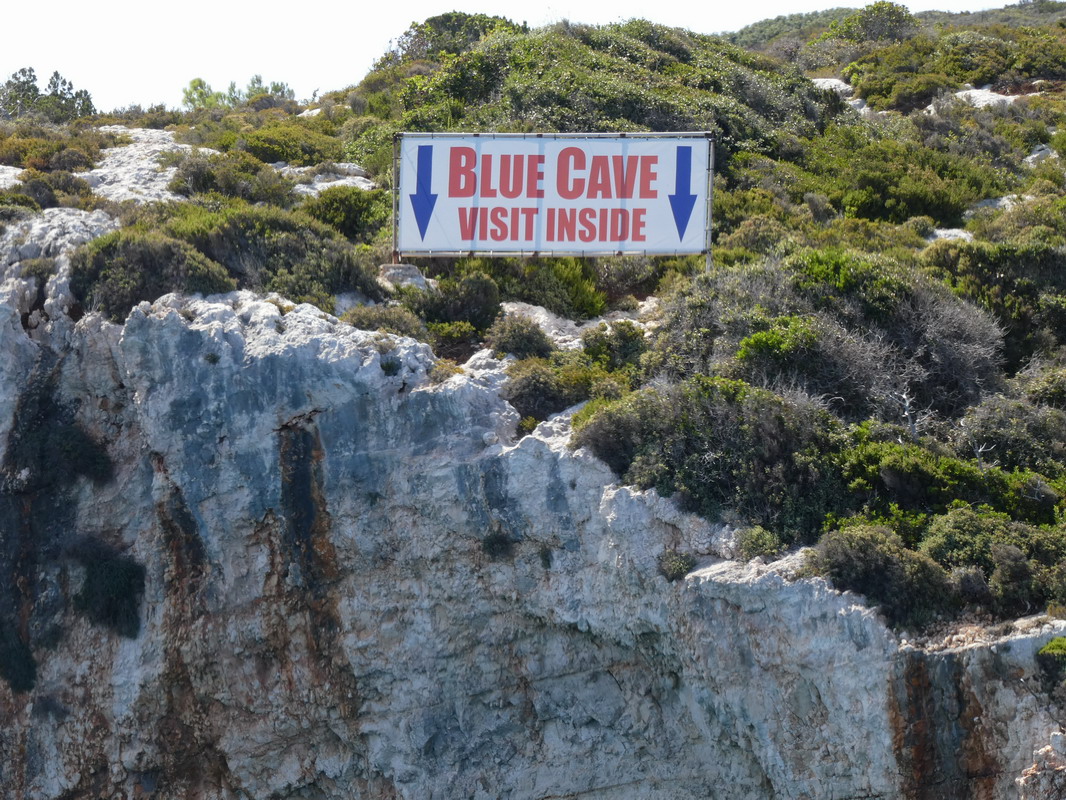
The Blue Caves are located on the northeast tip of the island, between Agios Nikolaos and Skinari Cape. They are generally visited during boat trips that include a visit to Shipwreck Bay, Navagio Bay


The headland before the Blue Caves


Boats stop and allow people to swim, but it was too cold for me. 


There is also access from the land, a series of steps leads down from the hill top -

We also visited Zante's best known tourist site, Shipwreck Beach or Navagio Bay. This is located on the northwest side of the island. This is the iconic photo that everyone knows -

The sheer white cliffs look like chalk. 


Approaching the beach it was nice to see that we were the first large tourist boat to arrive and there were very few people on the beach -

On 2 October 1980, a freightliner, the MV Panagiotis, ran aground in Navagio Beach during stormy weather and bad visibility. Some rumours say the ship was smuggling contraband, however official sources did not confirm this.


More and more tourist boats arrived and soon the beach was getting croweded.

In September 2018 there was a major rockfall when a massive sheet of rock fell 60 m. The beach was packed at the time but luckily no one was killed.


September 19, 2020

Melissani Lake, Kefalonia, Greece

Having visited Drogarati Cave on Kefalonia, the next attraction was Melissani Lake. 

Kefalonia is the largest of the Ionian Islands in western Greece. It's important natural features include the Drogarati caves and Melissani Lake. Melissani cave lake is located near Karavomilos on the east coast. It is a cave containing a lake. The roof of the chamber with the lake collapsed and when the sun is shining there is a beatiful scene of the clear lake water. Tourists are taken across the lake by boat and into the chamber beyond. 

Luckily when we arrived there was no queue at all. Entry is €6. Visitors walk down a sloping tunnel to reach the lake where the boats are waiting. With Covid-19 social distancing rules, the boats weren't as full as normal. A man rows the boat across the lake. 


The lake is 39 m deep. The water is so clear. Apparently eels live in the lake but I didn't see any.


At one end of the cavern is the Cave of Nymphs, so called because some ancient pottery was found there decorated with images of the god Pan and several nymphs. The lake was named after one of the nymphs, Melissanthi. The entrance to the dark chamber really reminded me of a mini version of the entrance to Deer Cave in Mulu, Malaysia. 


Geologist have studied the underground drainage of the island and have found that the Melissani lake water comes from the other side of the island, from the sinkholes at Katavothres. Katavothres is located on the tip of the headland north of Argostoli. There is a lighthouse there.


Just 3 km outside of Argostoli is the Katavothres Lagoon, a fascinating geological phenomenon. The name literally means ‘the swallowing hole’ and the lagoon features deep sink holes. The holes were investigated in the 1960s and a purple dye was poured into the holes to see where the water went – and revealed that the water passed through a number of underground rivers before re-emerging in Lake Melissani more than 15 km away. Two weeks later the same water pours into the sea at the village of Karavomilos. A watermill was erected here to demonstrate the resurging water.

See Wikipedia entry for Melissani Cave.

September 18, 2020

Drogarati Cave on Kefalonia, Greece

 Kefalonia is the largest of the Ionian islands, that lie off the west coast of Greece. 


The Drogarati Cave is a limestone cave that is open to the public as a show cave. It is located on the east coast near the town of Sami. It was discovered after a big earthquake exposed the entrance about 300 years ago. It was opened to the public in 1963. The ticket price has been reduced from  €5 to €4. It was compulsory to wear masks - it was September 2020, the year of the worldwide Covid-19 pandemic.


The cave is approximately 60 m deep. There are some 90-100 steps down to the entrance.


Inside there is a viewing area looking into the main chamber, “The Apotheosis Hall”. This chamber has been used for concerts. It is full of stalactites, many of which are broken. This is probably due to the frequent earthquakes. Kefalonia is the most seismically active part of western Greece. The island is being thrust up by major earthquakes (M >7.0) occurring on average once every 50 years. On 12 August 1953 a magnitude 7.2 event uplifted much of the island by about 60cm, and this was possibly the one that damaged many of the formations. 


An area of unbroken stal -


Interesting how the pool has been lined with a row of broken stal below the railings -


There is a path around the chamber. I didn't notice any passages off, so don't know how extensive the cave is. A large area of the floor of the main chamber is devoid of stalagmites and the ceiling above has unbroken stal -


In the centre the stal almost meet the roof -

A lovely streak bacon curtain -

I was using both a new camera and a new phone for taking photos, and the results were remarkably different. The above photos were taken with the camera, the ones below with the phone. 


Back at the entrance area, for a final look around before heading out -


 There is a cafe and small souvenir shop by the car park. 

We then had a short drive to the next attraction, Melissani Lake. 

August 30, 2020

International bat weekend

 August 29-30 was international bat weekend, with Aug 29 being international bat  night.The Bat Conservation Trust were holding a bat fest -


This was Bank Holiday weekend and was scheduled to be the coldest summer Bank Holiday on record!
After a heatwave earlier in August it had turned cold, grey and wet, 15 C in London. 

See more on Sustainable Learning www.


April 17, 2020

Bat Appreciation Day

Having blogged about bats and viruses earlier this week, I then found out that April 17th is Bat Appreciation Day. I'd never heard of this, I think it is an American thing that started in 2015. However I found a link to a UK site for bat appreciation day, on WinCalendar. It says :

"Bat Appreciation Day aims to raise awareness of the critical role that bats have on our ecosystem. Bats have faced scrutiny due to their appearance and how they are portrayed in the media. However, they are actually beneficial to agriculture as they pollinate plants and eat insects. This provides the benefit of being able to use less pesticides on their crops."


April 15, 2020

Bats and viruses

For centuries bats have had a bad reputation amongst the general public. They are portrayed negatively in folklore as well as real life. I wrote about this in 2008, "Batty friends in need of our protection".

Bats are also said to be carriers of viruses that can be passed to humans. See my website for more about bats and viruses. In 1998 bats were linked to the Nipah virus in Malaysia. Then in 2002 bats were linked to the SARS outbreak. The latest one is the coronavirus pandemic.

The coronavirus Covid 19 hit the world at the start of 2020. It started in Wuhan in China in Dec 2019. The virus was first reported in a live animal market. It was suggested that bats from a nearby cave might have been the cause, then this idea was squashed. Then in mid April a report suggested that "Stray dogs eating bat meat may have started pandemic". The Sky news report on 15 April wrote that a professor in "University of Ottawa's biology department, has suggested that stray dogs are the most likely intermediate host for the transmission of Sars-CoV-2 into humans. According to the study, the ancestor of the new coronavirus and its nearest relative - a bat coronavirus - infected the intestines of dogs. They then evolved before moving to humans." But scientists elsewhere are unconvinced.

Other reports again suggest the bats from Wuhan area are to blame. "Wuhan lab ‘experimented on bats from cave where coronavirus may have originated’ ", Metro 12 April and similar articles appeared in other media. Bats were caught in caves in Yunnan, about 1000 miles from Wuhan.
The Daily Mail 12 April suggests the "U.S. government gave $3.7million grant to Wuhan lab at center of coronavirus leak scrutiny that was performing experiments on bats from the caves where the disease is believed to have originated".

A 54 min documentary video on youtube that blames the Chinese Communist Party for the virus, from Epoch Times.

However it is still unclear whether scientists are to blame, or if the virus made the jump directly to humans, possibly by bats for sale in the market.

It is still very early days to know anything definite!

--

See more on Bat Conservation International .

--

An interesting article on CNN "The virus hunters who search bat caves to predict the next pandemic" on 27 April 2020. It describes how scientists capture bats each evening outside caves in China's Yunnan province. Blood is taken from the bats, oral and faecal swabs are taken and droppings collected. The scientists are testing for new pathogens. The organisation Predict, operates in 31 countries and are focusing on China, Myanmar and Kenya.