November 13, 2019

Caves of Drach, Majorca, Spain

Majorca is the largest of the Balearic Islands and lies off the southeast coast of Spain, in the Mediterranean. Much of the island is limestone and there are several caves open to tourists.

In 1968 I visited the Caves of Arta on the east side of the island. And more recently I went to the Caves of Drach, which are south of Arta.

Driving across the island from Palma, there is no obvious sign of limestone. The Caves of Drach are located on the outskirts of Porto Cristo and are the most famous of Majorca's cave. Cuevas del Drach or Dragon Caves were first explored by Martel.


I was on a group tour so our tickets had already been bought for us. I was horrified to see the large number of people waiting to go on the 11 am tour, including a school group. So it was just one long line of people through the cave.

Quite a few stairs lead down into the cave. The cave is really stunning, packed full of formations absolutely everywhere. Huge numbers of straws and thin stalactites.


The lighting was well done, thankfully without coloured lights. The cave was quite warm, probably due to the huge  number of visitors.


Guides were scattered throughout to keep an eye on people and to keep them moving.


Looking down into the lake -

We came to a huge seating area and it took ages for everyone to come in and sit down. Then 3 boats came towards us from across the lake, with musicians in one boat playing classical music. It was really atmospheric. This lasted for about 10 minutes.

You then have a chance to go for a ride on the boat but as there were so many people I didn't bother and made my way out. There were less people in this section as many were still in the concert hall.

Back at the entrance I had a chance to see the ticket office. Normal entry is €16, and €11 on a group tour.


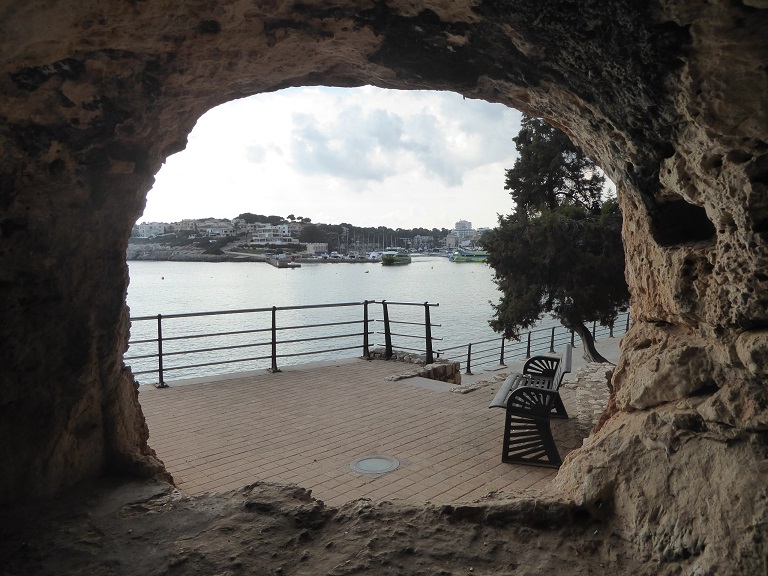
We then went into Porto Cristo and I had time to visit a tiny cave marked on my map. Black Cave is a sea cave, once used as a store for fishermen. It is located at the end of the beach -


Next to it is another tiny cave -


See more on the Caves of Drach and also the official website.

November 10, 2019

Cantal Caves - Cueva del Tescoro, Spain

In Oct 2019 I was on a cruise ship that stopped at Malaga, on the southern coast of Spain. The most famous show cave in the area is Nerja, I went there in 1968 during a holiday in Torremolinos on the Costa del Sol. This time I decided to go to El Tescoro Cave as it was only 11 km east of Malaga and accessible by bus.

From the bus stop it was a steep walk uphill to the cave. Entry was €4.65 for a self guided tour.


The Tescoro Cave is just one in the Cantal Caves complex.

Cantal Caves are the only sea cavern in Europe that can be visited by tourists and one of three existing in the world. The system connects to the sea through Cantal Cliffs. It is white limestones, brecciated and oolitic materials from Middle and Upper Jurassic period (180 - 135 million years BC). They are on the carbonated part of the Malaga stratigraphy and is mainly sub-horizontal. Sea water formed the caves. During marine regressions, speleothems formed, then during transgression the sea water polished the walls and speleothems. The massif was submerged underwater from 1.8 million to 360,000 years, during the Lower and Middle Pleistocene. The caves haven't been submerged since 240,000 years ago. So the main formation is marine, followed by karstic.

Cantal Caves is a group linked to the Cliffs, (connection between the sea and cave) comprised of Tesoro Cave, Victoria Cave, Goures Cave, Hope Cave and caverns RV-7 and RV-42.

Many of the caves have archaeological remains and are known for their cave paintings.The Tescoro Cave has 63 Palaeolithic panels, but none of these are in the show cave area. The show cave opened in 1991 and in 2005 became part of the Mediterranean Archaeological Park. The show cave is called Treasure Cave, also Higueron Cave, Swiss Cave or Cantal Cave.Treasure Cave has 6 chambers open to the public. The one which is closed, Breuil Hall, has most paintings. Victoria Cave has 5 chambers but is also not open to the public. The caves are protected.


Rock art in the Iberian peninsula dates to c. 32,000 BC. With anatomically modern human groups, the first graphic references are of animals, hands and complex signs. The main cave groups are in the French-Cantabrian zone, as well as in the province of Malaga. The art is found in the deepest zones of the caves with difficult access and far away from the habitable area. The painted animals are not usually those eaten by the humans that paint them.

At Cantal Caves the art is abundant, most surviving paintings are red, although there are some black or brown ones, and rock carvings. At Victoria Cave there are 8 panels with red paintings. At Breuil Hall of the Tesoro Cave there are 42 panels with black and red paintings together with 13 black and red ones and rock carvings in Eagle Hall.

The red, ochre and black colours came from iron and manganese oxides and some other elements such as mud and carbon from wood, bone or burnt teeth. The paint was applied either dry or as a paste or liquid based on some binders and by using pencils for definition. A yellow liquid clay applied with the fingers is not common.

At Cantal Caves there is a predominance of painted motifs over carvings (93 of 104), where red paintings are more plentiful, 74%, over black and brown pigments.

The methods to apply the paint were fingers for red and hands and possibly a quill. Charcoal was used in black paintings. Only one painting is in brown.

Most motifs are zoomorphic ones, signs and hands. e.g. a horse, goat, bird, bovid, a fish shape figure and a deer, gathered in pairs. There are spots and undefined figures. There are lots of signs of erosion. Anthropomorphic figure have no head, their central line being the body and the curved lines being arms and legs.

Cueva del Tescoro -
In the entrance hall there is a small display of information boards, about the history and geology etc. A series of steps lead down into the cave, with information displays on each landing.


There isn't a great deal to see in the caves. Not much stal. The audio tour gives info at various points. Firstly you go through the passages on the left, then return to the chamber in the photo above, and then go to the passage on the right side of the photo. At the end are 2 small lakes -


To go out I took the lift, as it is glass sided and gives some views as it passes up through the cave.

See more on El Tesoro Cave. And for more photos of the cave, see this page.

July 29, 2019

Underground London, ice well at Regents Canal

 A once a year chance to visit the Victorian ice wells that lie beneath the London Canal Museum. This event took place on Sunday, 28th July 2019. The London Canal Museum is near Kings Cross station, and is right by Regent's Canal.

Having paid to enter the museum, I joined a group and listened to a short explanation  by one of the guides about the canals and the history of the use of ice. The two ice wells were built by Carlo Gatti around 1857 and 1863, to store ice imported from Norway.

The ice was brought from the docks by canal barge to ice warehouse, lowered into the wells where it could be stored for months, then later distributed to the Victorian customers by horse and cart. The museum entrance was originally used by the horse carts to deliver the ice.

Carlo Gatti was from the Italian speaking part of Switzerland, and came to London in 1847 aiming to open a string of restaurants. He did really well and had opened his first restaurant within 2 years and by 1855 opened the first of 6 ice warehouses. Gatti was born on 27 July so the ice well was opened on the 28th as part of the weekend birthday celebration.
A model of the 2 wells -

We were then allowed to descend 2 ladders to the well. We had to wear suitable shoes, i.e. no sandals, and were given a helmet. The ladders were very sturdy and well fixed!

The first well is the larger of the two. Both are circular within square area. The wells are 10 m across and originally 13 m deep.


Looking up at the ground floor gallery -

Some old timber. There has always been a slight seepage of water into the wells from the dock.


One of the brick pillars

In the 2nd well, the bricks between the circular well and the square main walls -


Looking back to the larger well

Battlebridge Basin outside the museum, this leads to the Regent's Canal Dock (now known as Limehouse Basin) -

I then had a look around the museum which was packed full of displays and info boards. There is a replica horse ramp, this led up to the upper floor where the stables were.


Also on the upper gallery is a large display of items relating to the ice trade.

The London Canal Museum website.

And this text is from friendsofislingtonmuseum .


See also my blog on the ice well at Manor House Gardens at Lee in southeast London.

July 13, 2019

Underground London, foot tunnels under the Thames

There are two foot tunnels under the River Thames in London, at Greenwich and Woolwich. Both are in the Royal Borough of Greenwich. The purpose of the tunnels was to provide reliable all-weather access by local residents to the London shipyards and docks on the north side of the Thames.

The Greenwich tunnel is upstream of Woolwich and is used by 1.2 million people a year compared to 300,000 in the Woolwich tunnel. Both tunnels are open 24 hours a day, and have lifts and stairs. See Royal Greenwich webpage.


The Greenwich tunnel runs from Greenwich near the Cutty Sark on the south side to Millwall on the north bank. It was opened in 1902 and is 370 m long. The lift is new, 2012. Tunnel entrance at Greenwich -


The northern side -


And looking  back across the river to Greenwich -


The Woolwich tunnel was opened in 1912. It is 504 m long. Both entrances to the tunnels are Grade II listed buildings. Entrance on the south side -


The lift on the south side -
  

 Lift on the north side -

The north side -