December 21, 2014

Lanzarote - Cueva de los Verdes lava tube & Jameos del Agua

Cueva de los Verdes. It is located at the northeast of the island of Lanzarote in the Canary Islands.


Lanzarote has a volcanic origin. It was born through fiery eruptions. Today there are many inactive volcanoes, lava fields and lava tube caves.  The island emerged about 25 million years ago.
Verdes does not refer to the colour green, it is actually the name of a family. In the past people would shelter in the caves to hide from the pirates.
The lava tube is over 6 km long with an additional 1.6 km under the sea. About 2 km are open to the public. The cave measures more than 15 m wide and high. Steps lead down into the cave -

 and view from the main tourist entrance -
 The footpath -
 A lone Alocassia -
The entrance chamber which is quite large. A few more steps lead down into the tube. I was surprised by it’s size overall. The lighting was done very nicely, though we couldn’t see any natural openings because of the lights, also I don’t know if it changed the colour of the rocks.

 
Part way in the tube is a double passage, with a newer tube above the original one. We went to the theatre which has a stage and seats. We went back via the upper level. At one point is a long pool of water, only about 20 cm deep, but when it is still there is an amazing reflection of the high ceiling and it really looks like a deep pit. Absolutely amazing.
A very nice cave, simple but large compared to other lava tubes I have seen. No life in the cave.

From there we drove a short distance to to go to the 2nd cave, Jameos del Agua. This had a bar and toilets in the first part -
 
A tunnel with a large pool goes through the main area, this is home to lots of small white crabs, Munidopsis polimorphia. These are endemic to Lanzarote.
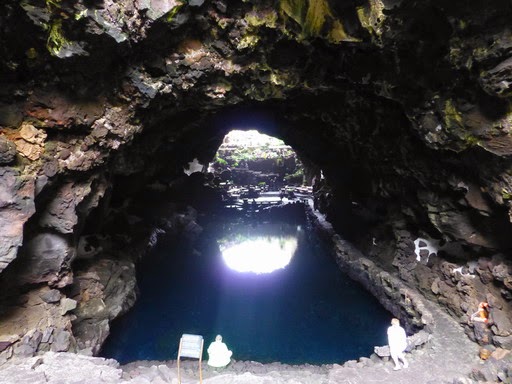
 
At the far side of the pool is another bar area - 

 
Beyond this is the ‘oasis pool’ used by the king of Spain, painted white and blue, with palm trees.

 
At the back of this is the theatre. Cesar Manrique. There is a dome which can be opened and closed

Steps lead down to the stage. Really atmospheric and I was quite content to sit there and listen to the music.

Looking down on the area

There is also a volcano museum but it wasn't overly interesting. The wall by the car park -
 
 The coast near the cave -
 
See next blog on Timanfaya National Park.
 
© Liz Price
No reproduction without permission

July 19, 2014

Dikti Cave, Crete, Greece

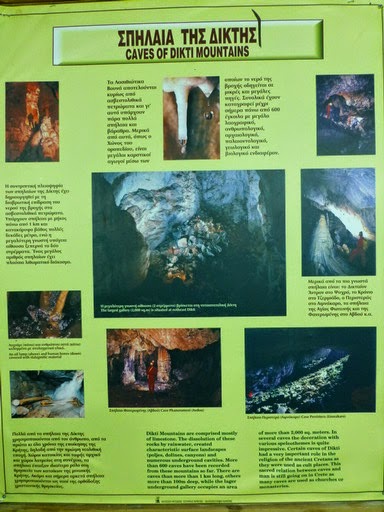
Dikti (Dicte) Cave, aka Psychro Cave or Diktaion Antron, is a show cave in the Dikti mountains on the east of the island of Crete, Greece. A visit to the cave is included on many day trips from the beach villages east of Heraklion on the north coast of Crete. After visiting Knossos, the tours go up into the mountains to the Lassithi Plateau.
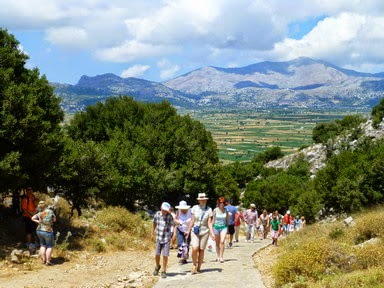
The Dikti mountains surround the plateau, which is at about 850 m. The highest mountain is Spathi 2148 m. There are many plateau in these mountains but Lassithi is the largest, lying on the north side of the plateau. At this height, olives and other crops no longer grow. Instead there is a sub alpine flora, with pines, oak, Cyprus, maples.There are many windmills for irrigation.

Dikti Cave is situated near the village of Psychro. It is quite a climb to the cave, up a long and winding road, although you can go by donkey for 10 one way.


The hills do not really look like limestone.
Entrance to the cave is €4. On the day I went there were so many people, there was a queue for the tickets, then it was a case of following a long line of people through the cave. This is the queue for the tickets -


The cave is basically a large single chamber. Many steps lead down to the bottom of the chamber which is packed full of stalagmites and stalactites.


There are electric lights and no flash photography is allowed. Needless to say some people did use flash and a lady working there was shouting "no flash". My photos are not good without flash, also it was hard to stop and take photos with the crowds of people.


There is a raised walkway all the way through and in places the stalagmites are used as handholds. Looking at the survey, it seems there is not much more to the cave, just another chamber off from the top of the steps. Temperature was 18-19° C.


To the right of the entrance is probably the way to the other part of the cave -


According to some Greek mythology, Zeus was reared on this mountain in a cave called Dictaeon Andron (Psychro Cave). Other stories say Zeus was born (and raised) in the cave, although other stories say he was born/raised elsewhere, or even came from the sky.

Zeus is the father of all gods.


Today they refer to it as stalagmite stalactite cave.

Washington Uni did a study on the skeletons found and determined from the DNA they people came from the Iraq area. Pottery from 7000 BC was found in the cave, also  bronze, metal, and clay models of sheep and goats. 100 goats were sacrificed at the cave (each year?) for the rebirth of Zeus.

Now 200,000 visitors a year to the cave. There are 3000 caves on Crete. My camera gps location said Oropedio, Lasithiou, Lasithi Kriti.


 © Liz Price
No reproduction without permission