March 18, 2014

Chillagoe caves, Australia

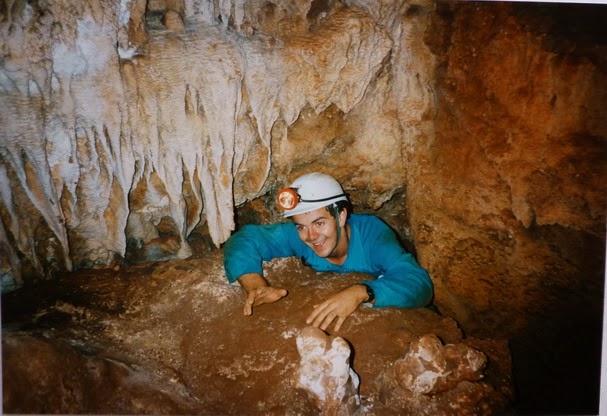
In 1988 I was living in Cairns, north Queensland, Australia. I did several caving trips to the Chillagoe area, which is in the outback, 215 km west of Cairns. Some of the caving trips were with the Chillagoe Caving Club, others I was working as a cave guide for a Cairns tour company.

Chillagoe is a small outback town, this is the post office -

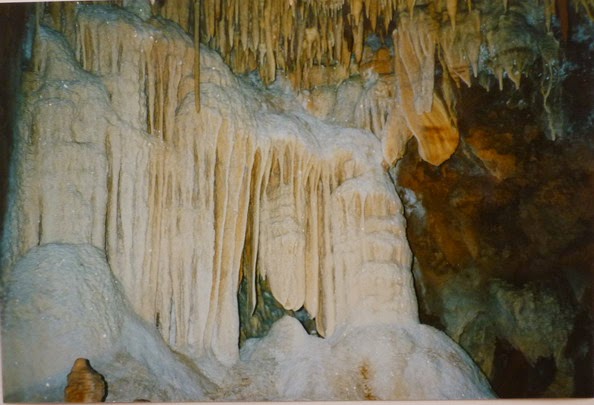
Some of the caves are beautiful with many formations.

These photos are not good, as I don't have a scanner, so just took photos of the photos!


I was incredibly lucky to visit Bugrake Cave as it is normally closed, owing to the beautiful formations. The small entrance is in a hillside and starts as a 55' pitch. The cave consists of 3 beautiful chambers, with masses of stal, a pure white floor, a ceiling covered in thousands of stals, straws and some huge helictites as well as tiny ones, pools, small gours etc. It was just wonderful. The cave is in good condition and the stal is clean, the only real damage being to the floor. The cave was hot. These photos are Bugrake Cave -


This cave is CH123 Ryans Creek - A very pretty but short cave. Almost a walk in entrance over boulders then into a large passage with coral, stal, a large curtain, bats and spiders. There were some long tree roots hanging down.


See my article on Chillagoe in the Brunei Times 2008.

March 17, 2014

Undarra lava tunnels, Queensland, Australia

The Undara [Undarra] Volcanic National Park is situated in central Queensland about 350 km south west of Cairns, Australia. It is important for its geology and ecology. There are many lava tubes and caves, formed after a huge volcanic eruption that occurred 190,000 years ago.

Undara is the Aboriginal word for 'long way', and perfectly describes the isolated Outback Australian
location. This part of Queensland is dry savanna woodland but the area around the caves has green rainforests with semi-evergreen vine thickets and perennial springs. These freshwater perennial springs support a variety of wildlife, such as kangaroos, wallabies, birds, frogs and snakes.


The Undara lava tubes are some of the longest in the world. According to Wikipedia, Bayliss Cave is over 1300 m long, and has bad air.

They are home to many bats, of 4 main species. Today tourists are taken to the mouth of Barkers Cave to watch the nightly bat exodus when they leave the cave to feed.

 I visited 2 of the lava tunnels in Nov 1988. From Cairns we drove up the Gillies, through Malanda and Mt Garnet and Yaramulla, then 23 km through the bush to Undara.

These photos are poor as I didn't have a scanner so just took photos of the photos!

Outside the only signs of it being a volcanic area are the brown magma stones. These have lots of holes.

Bayliss Cave is the longest in the Undara system. Bayliss has a small entrance in a small depression. The entrance collapse led into the tunnel proper, and we had to go past 2 dead and smelly possums. The passage is a uniform almost circular tunnel, about 25' high x 30' wide. It was reasonably straight and had a dried mud floor. The roof lowered in places.
 Eucalyptus roots hanging in the cave


There are a few bats. We came to a raised pile on the floor and beyond was some very glutinous and slippery mud like chocolate mousse. The roof lowered but the passage continued.


We drove to Barker Tunnel. This is near a hill capped with large boulders. Everyone (except me) wanted to dive in this cave as they were expecting a nice lake.


The entrance is large and a boulder slope leads down into the tunnel which is larger and straighter than Bayliss.

As we went through we disturbed a few bats then heard a sound like a waterfall which we soon realised was flying bats. Soon after a whole colony flew towards us and it began raining bat pee and poo! The stench was awful. The bats filled the air and it was an amazing sight. The floor became liquid guano and was revolting. We stopped when it got above shoe level.

It looked like the beginning of a lake in front so Carl waded out for a look, resulting in the 3 guys deciding to dive. We went back out to get the equipment and I was glad to be in  the fresh air. They inflated their boat at the entrance and carried it in.


 Remains of a kangaroo -


I wasn't really sure what the others were going to dive, but 3 of them kitted up and set off, using the dinghy as a sled. The rest of us waited in the bat shit. The divers disappeared around a corner but were never out of earshot. They didn't get further than upper thigh depth when they came to the end of a passage - a wall.

Apparently 10 years ago, a 2.5m lake had been dived, so obviously the water levels are now much lower indeed.

Some tunnels are home to a virulent lung fungus and in addition there is the strong smell from the bats, not to mention histoplasmosis, so I stuffed tissues up my nose!

After the trip, this was the only way we could wash, as there is a lack of water in the area -


sharing a plastic box


See more on Undara tunnels.

January 8, 2014

Conservationists save the Bracken Cave bats, Texas

Bracken Cave in Texas is quite famous as it the summer home to the world's largest bat colony. Millions of Mexican free-tailed bats live in the cave from March through till October, making this one of the largest concentration of mammals on earth.

An estimated 10 million bats emerge from the cave each night. The cave is just north of San Antonio.

In recent months the cave has been threatened by a possible nearby development. A San Antonio developer proposed to build 3800 homes on 1,500 acres just south of the cave area. The cave and surrounding area is owned and protected by Bat Conservation International.

Now it looks as if the building developer has dropped the project.

Read more about the bats and cave on Bat Conservation International.


December 22, 2013

400,000-year-old Hominin bones from cave in Spain

Excavations in caves in northern Spain have revealed hominin fossils that range in age from the early Pleistocene to the Holocene.The caves are in the Sierra de Atapuerca.

One site was found to contain the world’s largest collection of Middle Pleistocene hominin fossils, from at least 28 individuals4 dated to over 300,000 years ago.

The DNA has baffled scientists as the bones share a number of morphological features with fossils classified as Homo heidelbergensis and also show distinct Neanderthal-derived traits. This Sima de los Huesos hominin seems closely related to the lineage of Denisovans, an eastern Eurasian sister group to Neanderthals, from southwest Siberia.

The fossils were found in the 1990s but this news only came out in Dec 2013.

Info from Nature letter.See another write up in Nature .

December 14, 2013

Brazil cave snail Habeas

In Brazil, a new genus of snails has been found in a limestone cave threatened by quarrying. Three new species were found and Luiz Ricardo Simone of the Museu de Zoologia da Universidade de São Paulo has named the genus Habeas.

One of the snails is Habeas corpus. A Habeas corpus in legal terms is a writ requiring a person to be brought before a judge or into court, mainly to investigate lawfulness of his restraint.

In the case of the snail it is an attempt to conserve the cave and surroundings from quarrying. The cave is in the Caatinga, which is a type of desert vegetation, in Bahia, northeast Brazil.


See photos on this snail blog .

Reference:
Simone, L.R.L. (2013). Habeas, a new genus of Diplommatinidae from Central Bahia, Brazil (Caenogastropoda), with description of three new species. — Journal of Conchology 41: 519–525.
Abstract.

Cave invertebrates in Texas on endangered species act

The news items describes how 3 species of cave invertebrates in a cave in Texas have had their habitat saved, by being listed on the Endangered Species act. This is important news for caves/cavers worldwide.

Also it is relevant in our fight to  save Gunung Kanthan in Malaysia from being destroyed by Lafarge. Kanthan hill and cave are home to endemic species, in particular the trapdoor spider Liphistius kanthan. See also letters to the media.


The Texas news item can be seen on Commondreams.org , 22 Oct 2013. I've reproduced it here in case the original source goes.

Rare Cave-dwelling Creatures in Texas Hill Country Gain Protected Habitat Under Endangered Species Act

SAN ANTONIO - October 22 - The U.S. Fish and Wildlife Service finalized “critical habitat” protection today for three rare invertebrates in Comal and Hays counties, Texas. The designation protects 169 acres of habitat for the cave-dwelling animals, which include two beetles and a crustacean. The protected habitat includes subsurface areas that scientists have identified as critical to the animals’ survival.
“Protecting aquatic habitat for these tiny animals will help safeguard the special natural history of Texas for generations to come,” said Tierra Curry, a conservation biologist at the Center for Biological Diversity.
The animals — Comal Springs riffle beetles, Comal Springs dryopid beetles and Peck’s cave amphipods — were protected under the Endangered Species Act in 1997, after which the Center and allies filed a series of lawsuits to gain protected habitat for the animals, including subsurface areas.
The habitat areas set aside for the animals overlap, consisting of 39 acres of surface habitat and 139 acres of subsurface habitat for the Comal Springs dryopid beetle; 38 surface acres and 138 subsurface acres for the Peck’s cave amphipod; and 54 acres of protected surface habitat for the Comal Springs riffle beetle.

All three of the freshwater invertebrates are found nowhere in the world except four Texas springs, where they are threatened by groundwater pumping from the Edwards Aquifer.
Groups that filed suit to gain habitat protection for the species were the Center for Biological Diversity, Citizen’s Alliance for Smart Expansion and Aquifer Guardians in Urban Areas.

November 12, 2013

Chobar & Mahendra caves, Nepal

In 1987 I went to Nepal for the first time. There are not many caves in Nepal, but one of the most famous is just outside Kathmandu. This is Chobar Cave in a gorge of the same name.

Chobar village is about 9 km southwest of Kathmandu. The village overlooks the Bagmati River. The Jal Binayak temple is at the mouth of the Chobar Gorge and you can cross the Bagmati River here. The suspension bridge was made in Scotland more than 100 years ago.

There are various legends about the gorge and caves. One legend says the chasm was cut by Manjushri's sword (Manjushree).All the water from Kathmandu Valley drains through this gorge.
Chobar Gorge


The main cave is/was called Sparrow Pigeon Cave
This is a 1997 view of the entrance, and you can see a bird flying in the entrance.Since my visit, a team of French cavers mapped the caves in 2007.

At the time I was in Nepal, the only show cave was Mahendra Gupha. Mahendra Gupha is located north of Pokhara, the area is known as Batulechaur. I don't have any photos of the cave, but this is one of Mahendra Gorge

The cave was electrically lit but there were only half a dozen lights so I was glad of my torch. The cave is about 240 m long with 2 entrances. The main one has steps leading down to a wide arch. The main passage runs north-south and ends in breakdown. The cave is developed below coarse conglomerate and is horizontal. There is a stream on the left of the main passage.

In 1979 according to Gebauer the roof was covered with stalactites but none remain - they've all been sold. There are 2 small Siva linga. The 2nd entrance is small and muddy. The cave was rather disappointing.

There are some photos of Mahendra Cave here. The area is interesting geologically, as it is carbonaceous Holocene conglomerates, not real limestone!


Refs:
GEBAUER, H Daniel (1983) CAVES OF INDIA AND NEPAL, 166p.

PRICE, Liz (1988) Cave hunting in Nepal. Cerberus Spel. Soc. Vol 17, No 6, p93-94.