July 19, 2014

Dikti Cave, Crete, Greece

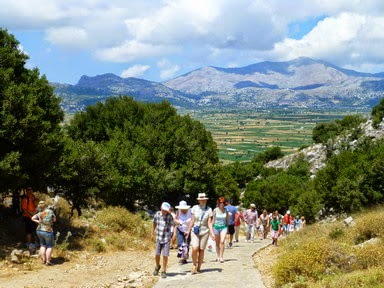
Dikti (Dicte) Cave, aka Psychro Cave or Diktaion Antron, is a show cave in the Dikti mountains on the east of the island of Crete, Greece. A visit to the cave is included on many day trips from the beach villages east of Heraklion on the north coast of Crete. After visiting Knossos, the tours go up into the mountains to the Lassithi Plateau.

The Dikti mountains surround the plateau, which is at about 850 m. The highest mountain is Spathi 2148 m. There are many plateau in these mountains but Lassithi is the largest, lying on the north side of the plateau. At this height, olives and other crops no longer grow. Instead there is a sub alpine flora, with pines, oak, Cyprus, maples.There are many windmills for irrigation.

Dikti Cave is situated near the village of Psychro. It is quite a climb to the cave, up a long and winding road, although you can go by donkey for 10 one way.


The hills do not really look like limestone.
Entrance to the cave is €4. On the day I went there were so many people, there was a queue for the tickets, then it was a case of following a long line of people through the cave. This is the queue for the tickets -


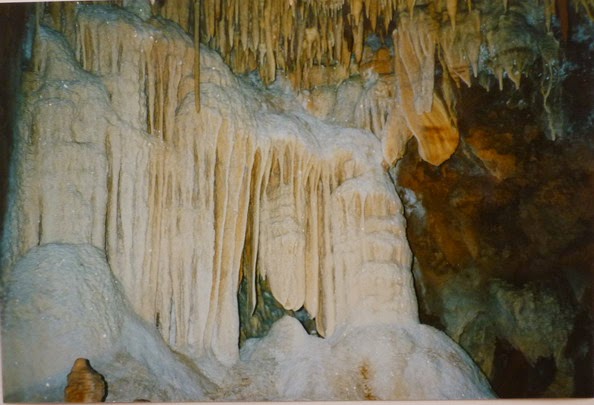
The cave is basically a large single chamber. Many steps lead down to the bottom of the chamber which is packed full of stalagmites and stalactites.


There are electric lights and no flash photography is allowed. Needless to say some people did use flash and a lady working there was shouting "no flash". My photos are not good without flash, also it was hard to stop and take photos with the crowds of people.


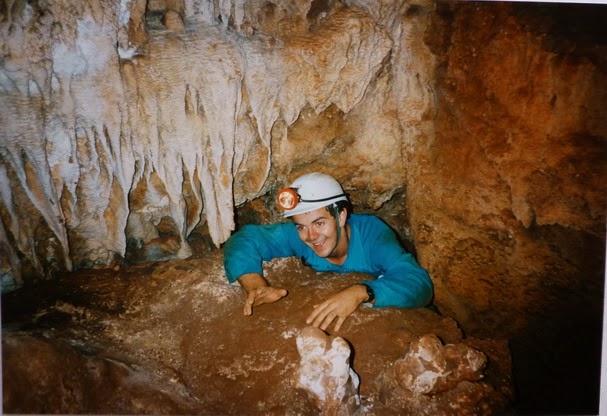
There is a raised walkway all the way through and in places the stalagmites are used as handholds. Looking at the survey, it seems there is not much more to the cave, just another chamber off from the top of the steps. Temperature was 18-19° C.


To the right of the entrance is probably the way to the other part of the cave -


According to some Greek mythology, Zeus was reared on this mountain in a cave called Dictaeon Andron (Psychro Cave). Other stories say Zeus was born (and raised) in the cave, although other stories say he was born/raised elsewhere, or even came from the sky.

Zeus is the father of all gods.


Today they refer to it as stalagmite stalactite cave.

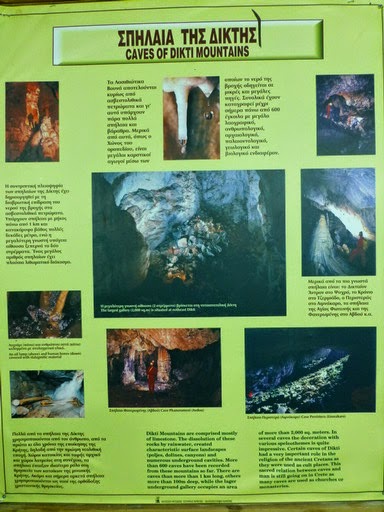
Washington Uni did a study on the skeletons found and determined from the DNA they people came from the Iraq area. Pottery from 7000 BC was found in the cave, also  bronze, metal, and clay models of sheep and goats. 100 goats were sacrificed at the cave (each year?) for the rebirth of Zeus.

Now 200,000 visitors a year to the cave. There are 3000 caves on Crete. My camera gps location said Oropedio, Lasithiou, Lasithi Kriti.




 © Liz Price
No reproduction without permission


May 1, 2014

Torr Works Quarry, Somerset, England

A very quick view over the top of Torr Works Quarry at East Cranmore/Downhead, near Shepton Mallet, Somerset, England. It is a quarry for limestone.


Operated by Aggregate Industries, who took over Foster Yeoman. It is also known as Merehead Quarry.

April 2, 2014

Wookey Hole Caves used for Three phone advert


This advert is shown on British TV in 2014. It was filmed in Wookey Hole caves in Somerset, England.
The ad is for free 0800 calls on Three network phones.

March 18, 2014

Chillagoe caves, Australia

In 1988 I was living in Cairns, north Queensland, Australia. I did several caving trips to the Chillagoe area, which is in the outback, 215 km west of Cairns. Some of the caving trips were with the Chillagoe Caving Club, others I was working as a cave guide for a Cairns tour company.

Chillagoe is a small outback town, this is the post office -

Some of the caves are beautiful with many formations.

These photos are not good, as I don't have a scanner, so just took photos of the photos!


I was incredibly lucky to visit Bugrake Cave as it is normally closed, owing to the beautiful formations. The small entrance is in a hillside and starts as a 55' pitch. The cave consists of 3 beautiful chambers, with masses of stal, a pure white floor, a ceiling covered in thousands of stals, straws and some huge helictites as well as tiny ones, pools, small gours etc. It was just wonderful. The cave is in good condition and the stal is clean, the only real damage being to the floor. The cave was hot. These photos are Bugrake Cave -


This cave is CH123 Ryans Creek - A very pretty but short cave. Almost a walk in entrance over boulders then into a large passage with coral, stal, a large curtain, bats and spiders. There were some long tree roots hanging down.


See my article on Chillagoe in the Brunei Times 2008.

March 17, 2014

Undarra lava tunnels, Queensland, Australia

The Undara [Undarra] Volcanic National Park is situated in central Queensland about 350 km south west of Cairns, Australia. It is important for its geology and ecology. There are many lava tubes and caves, formed after a huge volcanic eruption that occurred 190,000 years ago.

Undara is the Aboriginal word for 'long way', and perfectly describes the isolated Outback Australian
location. This part of Queensland is dry savanna woodland but the area around the caves has green rainforests with semi-evergreen vine thickets and perennial springs. These freshwater perennial springs support a variety of wildlife, such as kangaroos, wallabies, birds, frogs and snakes.


The Undara lava tubes are some of the longest in the world. According to Wikipedia, Bayliss Cave is over 1300 m long, and has bad air.

They are home to many bats, of 4 main species. Today tourists are taken to the mouth of Barkers Cave to watch the nightly bat exodus when they leave the cave to feed.

 I visited 2 of the lava tunnels in Nov 1988. From Cairns we drove up the Gillies, through Malanda and Mt Garnet and Yaramulla, then 23 km through the bush to Undara.

These photos are poor as I didn't have a scanner so just took photos of the photos!

Outside the only signs of it being a volcanic area are the brown magma stones. These have lots of holes.

Bayliss Cave is the longest in the Undara system. Bayliss has a small entrance in a small depression. The entrance collapse led into the tunnel proper, and we had to go past 2 dead and smelly possums. The passage is a uniform almost circular tunnel, about 25' high x 30' wide. It was reasonably straight and had a dried mud floor. The roof lowered in places.
 Eucalyptus roots hanging in the cave


There are a few bats. We came to a raised pile on the floor and beyond was some very glutinous and slippery mud like chocolate mousse. The roof lowered but the passage continued.


We drove to Barker Tunnel. This is near a hill capped with large boulders. Everyone (except me) wanted to dive in this cave as they were expecting a nice lake.


The entrance is large and a boulder slope leads down into the tunnel which is larger and straighter than Bayliss.

As we went through we disturbed a few bats then heard a sound like a waterfall which we soon realised was flying bats. Soon after a whole colony flew towards us and it began raining bat pee and poo! The stench was awful. The bats filled the air and it was an amazing sight. The floor became liquid guano and was revolting. We stopped when it got above shoe level.

It looked like the beginning of a lake in front so Carl waded out for a look, resulting in the 3 guys deciding to dive. We went back out to get the equipment and I was glad to be in  the fresh air. They inflated their boat at the entrance and carried it in.


 Remains of a kangaroo -


I wasn't really sure what the others were going to dive, but 3 of them kitted up and set off, using the dinghy as a sled. The rest of us waited in the bat shit. The divers disappeared around a corner but were never out of earshot. They didn't get further than upper thigh depth when they came to the end of a passage - a wall.

Apparently 10 years ago, a 2.5m lake had been dived, so obviously the water levels are now much lower indeed.

Some tunnels are home to a virulent lung fungus and in addition there is the strong smell from the bats, not to mention histoplasmosis, so I stuffed tissues up my nose!

After the trip, this was the only way we could wash, as there is a lack of water in the area -


sharing a plastic box


See more on Undara tunnels.

January 8, 2014

Conservationists save the Bracken Cave bats, Texas

Bracken Cave in Texas is quite famous as it the summer home to the world's largest bat colony. Millions of Mexican free-tailed bats live in the cave from March through till October, making this one of the largest concentration of mammals on earth.

An estimated 10 million bats emerge from the cave each night. The cave is just north of San Antonio.

In recent months the cave has been threatened by a possible nearby development. A San Antonio developer proposed to build 3800 homes on 1,500 acres just south of the cave area. The cave and surrounding area is owned and protected by Bat Conservation International.

Now it looks as if the building developer has dropped the project.

Read more about the bats and cave on Bat Conservation International.